I am reading Four Seasons in Rome, by Anthony Doerr, and I just read a section that reminds me of the blog post I wrote back in October of 2006 on "drawing and painting"...
This excerpt offers Doerr's take on the importance of true observation:
In 1976, a doctoral student at the University of Nottingham in England demonstrated that randomizing letters in the middle of words had no effect on the ability of readers to understand sentences. In tihs setncene, for emalxpe, ervey scarbelmd wrod rmenias bcilasaly leibgle. Why? Because we are deeply accustomed to seeing letters arranged in certain patterns. Because the eye is in a rush, and the brain, eager to locate meaning, makes assumptions.
This is true of phrases too. An author writes "crack of dawn" or "sidelong glance" or "crystal clear" and the reader's eye continues on, at ease with combinations of words it has encountered innumerable times before. But does the reader, or the writer, actually expend the energy to see what is cracking at dawn or what is clear about a crystal?
The mind craves ease; it encourages the senses to recognize symbols, to gloss. It makes maps of our kitchen drawers and neighborhood streets; it fashions a sort of algebra out of life. And this is useful, even essential---X is the route to work, Y is the heft and feel of a nickel between your fingers. Without habit, the beauty of the world would overwhelm us. We'd pass out every time we saw---actually saw---a flower. Imagine if we only got to see a cumulonimbus cloud or Cassiopeia or a snowfall once a century: there'd be pandemonium in the streets. People would lie by the thousands in the fields on their backs.
We need habit to get through a day, to get to work, to feed our children. But habit is dangerous, too. The act of seeing can quickly become unconscious and automatic. The eye sees something---gray-brown bark, say, fissured into broad, vertical plates---and the brain spits out tree trunk and the eye moves on. But did I really take the time to see the tree? I glimpse hazel hair, high cheekbones, a field of freckles, and I think Shauna. But did I take the time to see my wife?
"Habitualization," a Russian army-commissar-turned-literary-critic named Viktor Shklovsky wrote in 1917, "devours works, clothes, furniture, one's wife, and the fear of war." What he argued is that, over time, we stop perceiving familiar things---words, friends, apartments---as they truly are. To eat a banana for the thousandth time is nothing like eating a banana for the first time. To have sex with somebody for the thousandth time is nothing like having sex with that person for the first time. The easier an experience, or the more entrenched, or the more familiar, the fainter our sensation of it becomes. This is true of chocolate and marriages and hometowns and narrative structures. Complexities wane, miracles become unremarkable, and if we're not careful, pretty soon we're gazing out at our lives as through a burlap sack.
In the Tom Andrew Studio I open my journal and stare out at the trunk of the umbrella pine and do my best to fight off the atrophy that comes from seeing things too frequently. I try to shape a few sentences around this tiny corner of Rome; I try to force my eye to slow down. A good journal entry---like a good song, or sketch, or photograph---ought to break up the habitual and lift away the film that forms over the eye, the finger, the tongue, the heart. A good journal entry ought to be a love letter to the world.
Leave home, leave the country, leave the familiar. Only then can routine experience---buying bread, eating vegetables, even saying hello---become new all over again.

-----Anthony Doerr, Four Seasons in Rome
I love that. It inspires me to paint, to write, and to simply appreciate.
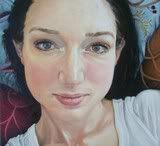
Photo shows my "Holding and Beholding" oil painting (above right).