Showing posts with label art. Show all posts

Wednesday, March 18, 2009

When Portraits are a Requirement...

...please consider spending $5,000 to $15,000 on me, rather than $50,000 to $100,000 on Daniel Greene!

From: http://thestevies.com/CXONews/February2006FullText.html --

PORTRAIT OF THE CXO AS A SUCCESSFUL MAN (OR WOMAN)

Having your portrait painted is often a necessity for the CXO who has reached a certain level of success, and is perhaps a more popular custom in the United States than in other countries. It is a requirement, rather than the ego trip some might think. We spoke to practitioners of the art to find out more.

Daniel E. Greene, NA

Daniel Greene is one of the best known and most experienced portrait artists in the United States, and could probably write a book on the illustrious people he has had in his studio. These range from heads of state, to media personalities such as Bob Schieffer and Rush Limbaugh, and to senior executives of corporations such as American Express, IBM, Dupont and Wendy’s. If studio walls had ears, his would have some stories to tell.

A former president of the American Association of Certified Accountants once told Daniel that while sitting for his portrait he had decided to write his autobiography. The opening chapter was set in the studio as he was being painted, and everything else that happened in his life occurred as flashbacks.

That was in the days when Daniel worked out of his former studio in New York City. Nowadays, he travels to the sitter’s location with a photographer for a session of carefully chosen digital images. From these he selects about twenty-five of the most suitable, the final image to be used being approved by the sitter. This speeds up the process: a portrait that once took up to ten sessions over several months now takes about three to four months to complete, with a last sitting at Greene’s Westchester studio for the final touches.

Daniel Greene works mostly in oils, and occasionally in pastels. A half-figure portrait will cost from $35,000, but the average three-quarter-length portrait will range between $45,000 to $67,500, depending on the complexity of the background. Each portrait has a guarantee of satisfaction. If the sitter is not satisfied, he can return the portrait without paying, but that has not happened so far.
Daniel Greene’s work has been exhibited around the world, His portraits of Eleanor Roosevelt are on exhibition at Hyde Park, and a compilation of his famous “Subway Series” paintings was used on the front and back covers of the Official Guide to the 2004 Republican National Convention. You can view more samples of his work at his website, www.danielgreeneartist.com.

Friday, February 27, 2009

Happy Birthday to Me!!!

The smallest details change everything....

Wednesday, September 24, 2008

I designed a logo for the first time, for my friend and dentist, Dr. Jeffrey Schroeder, whose South Tampa office is at 3733 W. Neptune (813-254-1007). I love his office, which is bursting at the seams with Key West flavor and brightly colored artwork and, of course, with the incredible friendliness and expertise of the Doctor and his assistants. So, when it came time to create the logo, we went for a Florida mangrove theme. Take care of your roots, and your health blooms! Dr. Schroeder is currently working on developing a giant sign sporting the logo and lit from within, for the front of his office building. I can't wait to see it!

Tuesday, July 15, 2008

My TV interview on Tampa's Ch. 10 news (CBS affiliate):


Thanks David Leonard!

Wednesday, January 30, 2008

I'm back from speaking at the Duke Conference. I loved it.

Below is a photo taken by Gary Wang - mentioned below - back in 1996. He and some friends painted over nearly the entire Duke bridge, wiping out everything except for a lone rose, which they incorporated into the "we were bored" phrase. He did not know me at the time -- and didn't know I'd painted that rose for my sorority, AOII!


Favorite moments at the Duke conference included:


Feeling 10 years younger because everything reminded me of my college years.


Conversations about the ontology/metaphysics/meaning of art and music and life.


Reuniting with my friend Juliessa.


And who would have thought Duke had produced so many artists? Just to name a few...


Ray Eddy went into consulting after graduating from Duke, then went back to Duke for a masters in teaching. He then worked for UNC at Chapel Hill in their student affairs office, before leaving them to start his own company, a band camp and band instruction group. There's more. He then won a job at Universal Studios as the stunt man who plays Indiana Jones. And I thought I had an outlandish career story!!


Ge Wang (a.k.a., Gary) forged a career in "research and education at the intersection of computer science and music." He is an assistant professor of music at Stanford, where he creates and uses audio software to build orchestral surround-sound musical experiences. And he has a talent for visual art, too: he never mentioned a word about it during the conference, but a quick visit to his website reveals his sketchbook portfolio.


Viswa Subbaraman has co-founded an opera company in Houston, Texas, where he is also artistic director and conductor. His talent as a conductor has won him a Fulbright scholarship and international recognition. He makes me want to listen to more classical music and expand my horizons.


Lynn Ennis is an artist who's main medium is other artists. That is to say, she's a museum curator at North Carolina State University in Raleigh. I was anxious to meet her, and was so glad to find her friendly and encouraging. I'm hoping she will soon join blogger and start writing!


Mark Mosrie is a renowned professional photographer based in Nashville, Tennessee. His portfolio speaks for itself, but I'll add one word: gorgeous. He's traveled the world, and the world is lucky.


Plus I met lots of students with interesting stories of their own. Who knows, maybe Dana Salah will be a voice we hear in the music world one day.


Wednesday, January 23, 2008

...

My career story is a love story. I just realized that.

Art was my first love. I started out as a dreamy-eyed little girl who wanted nothing more than to read fairytales and draw pictures of princesses. The books changed to Jane Austin and the Bronte sisters, and the pictures became portraits and life-drawn sketches, but for the most part, that dreamy identity remained astonishingly intact all the way through the rough and tumble of high school.

When I went to Duke, I took the Arts Focus classes, staffed the literary magazine and contributed art and poetry to its pages, and joined AOII, where I provided the sorority its every t-shirt design, poster design, and bridge painting. I drew more portraits. I studied abroad in Paris, where I visited an endless supply of museums from the Louvre to the Musee d'Orsay to Rodin to Picasso. And I drew more portraits. In my senior year, Duke Student Government commissioned me to create the art for a poster advertising that year's Homecoming festivities. They paid me $550 and I was thrilled.

My love for art was hands-on, tangible, vibrant: a living thing. My interest in law lay more in the line of a detached admiration. I appreciated the legal dramas I saw on TV and other media; I greatly respected what lawyers were able to achieve. “To Kill a Mockingbird” was one of my favorite books, but I wanted to be writing the novel, or painting the courtroom scene, not arguing the case.

Does any of this sound like someone headed for law school? No.

But at the same time, law was a suitor that was more than willing to have me. My LSAT score and my grades, especially in the English classes, made me a great catch, and the University of Florida, the one school I'd applied to, opened welcoming arms. My family approved of the match: not one of them had ever been an attorney, and I believe that made them all the more convinced that it was the perfect career choice. I felt pressure to choose the career that was steady, lucrative, and respected. I was sure I did not have the guts to stomach a life wedded to the volatile, self-revelatory world of art.

So, I went to law school. I stayed away from art for the next three years, and I had to force myself through each day of studying precedent and statutes. But I didn't want to be a quitter. I worked hard, graduated with honors and a certificate for commitment to pro bono work, passed the Bar on my first try, and felt extremely proud. I tried to persuade myself that I was well-matched to this career. I even took the Myers-Briggs Personality Test online and fudged the answers to make it say that my personality was best-suited to become an advocate/counselor/lawyer. I told myself I didn't miss art at all.

Then I went to work. I started out with a boutique law firm that took national cases, defending individuals and corporations accused of white-collar crimes. I hated it. I was working long hours, including occasional all-nighters, and my brain was so busy running on a work treadmill that it was starving for downtime, for dreaminess and idle philosophizing. I started to view my impressive downtown skyscraper office as a prison, and my impressive tailored suits felt like prison-wear.

I tried a different type of law firm, one that was smaller-scale, more laid-back and casual, and which offered more pro bono services. The firm worked mostly with plaintiff's personal injury claims and class action suits. Life was better, but it still felt weirdly... wrong.

Around this time, my boyfriend of that past year proposed to me. I accepted, but my intuition told me he was the wrong person for me. I broke off the engagement within the month. I began to consider that maybe a career was a sort of marriage. If so, I'd gotten married to LAW too quickly. I had settled for the wrong “person.”

Just a few months after breaking off my engagement, I followed by
breaking up with my career. And over the course of the next several months, I focused on gathering up the courage to revisit my old love, to see if Art would take me back.

Art and I reunited, and everything was amazing: passion, fireworks, better than ever before. I still felt afraid of the risks, but I was buoyed with optimism, thrilled with possibilities.

That was the honeymoon period. I had to wake up to the fact that even work you love – is work. I had to discover unknown wells within myself of discipline, motivation, and time-management. Maybe a marriage between a husband and wife is like that, too.

In a law firm, you have three categories of worker: the grinder, the minder, and the finder. The grinder cranks out the grueling (billable) hours and is least well-paid. The minder manages the business affairs. The finder finds clients, is most valuable, and best-paid. When you are a one-person business enterprise, you are grinder, minder, and finder. Fortunately, I love this grind, and I'm not too bad at minding shop. And the finding is often my favorite part, because it feels so good when people appreciate my art, and/or take interest in this crazy love story at the heart of my career change.

In the end, every day that I wake up and make art for my living is another day of creating my own happily ever after. I don't have the whole canvas painted yet, but I'm working on it...

Photos in this post show my Sketch of a Model (above top) and an image, taken by a friend, of a rainbow landing on my home studio (above right).

Friday, January 11, 2008

I am reading Four Seasons in Rome, by Anthony Doerr, and I just read a section that reminds me of the blog post I wrote back in October of 2006 on "drawing and painting"...

This excerpt offers Doerr's take on the importance of true observation:

In 1976, a doctoral student at the University of Nottingham in England demonstrated that randomizing letters in the middle of words had no effect on the ability of readers to understand sentences. In tihs setncene, for emalxpe, ervey scarbelmd wrod rmenias bcilasaly leibgle. Why? Because we are deeply accustomed to seeing letters arranged in certain patterns. Because the eye is in a rush, and the brain, eager to locate meaning, makes assumptions.

This is true of phrases too. An author writes "crack of dawn" or "sidelong glance" or "crystal clear" and the reader's eye continues on, at ease with combinations of words it has encountered innumerable times before. But does the reader, or the writer, actually expend the energy to see what is cracking at dawn or what is clear about a crystal?

The mind craves ease; it encourages the senses to recognize symbols, to gloss. It makes maps of our kitchen drawers and neighborhood streets; it fashions a sort of algebra out of life. And this is useful, even essential---X is the route to work, Y is the heft and feel of a nickel between your fingers. Without habit, the beauty of the world would overwhelm us. We'd pass out every time we saw---actually saw---a flower. Imagine if we only got to see a cumulonimbus cloud or Cassiopeia or a snowfall once a century: there'd be pandemonium in the streets. People would lie by the thousands in the fields on their backs.

We need habit to get through a day, to get to work, to feed our children. But habit is dangerous, too. The act of seeing can quickly become unconscious and automatic. The eye sees something---gray-brown bark, say, fissured into broad, vertical plates---and the brain spits out tree trunk and the eye moves on. But did I really take the time to see the tree? I glimpse hazel hair, high cheekbones, a field of freckles, and I think Shauna. But did I take the time to see my wife?

"Habitualization," a Russian army-commissar-turned-literary-critic named Viktor Shklovsky wrote in 1917, "devours works, clothes, furniture, one's wife, and the fear of war." What he argued is that, over time, we stop perceiving familiar things---words, friends, apartments---as they truly are. To eat a banana for the thousandth time is nothing like eating a banana for the first time. To have sex with somebody for the thousandth time is nothing like having sex with that person for the first time. The easier an experience, or the more entrenched, or the more familiar, the fainter our sensation of it becomes. This is true of chocolate and marriages and hometowns and narrative structures. Complexities wane, miracles become unremarkable, and if we're not careful, pretty soon we're gazing out at our lives as through a burlap sack.

In the Tom Andrew Studio I open my journal and stare out at the trunk of the umbrella pine and do my best to fight off the atrophy that comes from seeing things too frequently. I try to shape a few sentences around this tiny corner of Rome; I try to force my eye to slow down. A good journal entry---like a good song, or sketch, or photograph---ought to break up the habitual and lift away the film that forms over the eye, the finger, the tongue, the heart. A good journal entry ought to be a love letter to the world.

Leave home, leave the country, leave the familiar. Only then can routine experience---buying bread, eating vegetables, even saying hello---become new all over again.

-----Anthony Doerr, Four Seasons in Rome

I love that. It inspires me to paint, to write, and to simply appreciate.

Photo shows my "Holding and Beholding" oil painting (above right).

Tuesday, June 19, 2007

I Met Penelope Trunk! And she is the friendliest "antisocial" blogger-turned-book-author you'll ever meet.

Look her up here: http://blog.penelopetrunk.com/

I stumbled upon her blog about two weeks ago. Then, Monday, my friend Jenn pointed out that Penelope was visiting Tampa within a few hours for a book signing.

A number of people have complained about the fact that Penelope, who has ultimately achieved success by offering financial and career-related advice, has herself experienced plenty of difficulty in those very areas on her way up. I think her honesty is refreshing and inspiring, and I love her counter-intuitive (yet well-researched) advice. Just a few of my favorite items from Penelope Trunk:

You can put a number on happiness. It's a $40,000 annual salary.    (?!?!)

Perfectionism is completely at odds with achieving perfection.

Exercise boosts your IQ.

Also, she's funny. For more, you want to visit her website or blog, or buy her book! http://penelopetrunk.com/


What else can I tell you?


Well, I am really loving a new painting I've done in pastel.

This is a portrait of a house, rather than a person, but I feel like this house has all the personality of a human being.

I love how the trees' shadows work their way over everything. It unites every part of the picture.

And the composition pleases me, with its zigzagging lines drawing the eye all over the page. I can't wait to paint more homescapes!

Friday, March 09, 2007

Magic! Abracadabra! Presto-chango! More on that topic in a minute, but first a few updates:

On the news front, I am excited to have met Jackie Silver, who has a fascinating website about the secrets of "Aging Backwards"; one look at her testifies to her expertise: http://www.agingbackwards.com/. She has a recurring spot on NBC's Tampa morning show, Daytime, and she is talking to their producer about possibly having me on as a guest at some point. Yay! I love these opportunities!

I'm also set to have an ad and a brief editorial come out in the "New and Notable" section of Tampa Bay Illustrated's April issue. I tried to sneak in a bit of an engagement announcement for my sister there. Dr. Katie Gres is now engaged to the very wonderful Steven Gold! But they didn't publish that part...

My good friend Jim Kennedy loved his portrait of his daughter Bridget and the family treasure, Bing (see below)!

Photo Sharing and Video Hosting at Photobucket Photo Sharing and Video Hosting at Photobucket

Speaking of the movies, I saw "The Illusionist" recently.

I enjoyed the puzzles of "The Illusionist," and I won't spoil any surprises for you. I will say I wonder if anyone else saw foreshadowing in Eisenheim's (Edward Norton's) trick where he shows Sophie (Jessica Biel) her mirror image? And I love Paul Giamatti in every role he disappears into. All of the magic tricks had me fascinated and confused, and I loved watching the writer's commentary and finding out some of the magician's secrets.

Here's where we get to the aforementioned main topic of my post!

The audience in a movie theater is not so different from the old-time audience for a magician. The actors are magicians, transforming into characters. And the plot of the story is itself the best trick. Some viewers (the Biel character sort of viewer) might get enormous enjoyment out of watching passively, with a complete suspension of disbelief. The Giamatti-type viewer might be working hard to figure out the plot ahead of the movie's conclusion, and loving both the thrill of solving the mystery and the delight of being mystified. The crown-prince (Rufus Sewell) type would sneer condescendingly at a movie for the transparency of its illusions, would feel personally insulted by any "unsolvable" aspect of a movie, and would therefore never watch any movie with any genuine delight.

I've said before, in my biography on my website, that I feel a sort of magic in the art that I create. In the completion of a painting, there's a certain moment when the pigment and the composition come together, ready to burst off the page, and I feel like doing a happy dance around my easel, thumping my chest and raising my hands to the sky. Picture something like Tom Hanks on "Cast Away," exulting, "I have made FIRE!! Look what I have created!!" I hope none of my viewers are the prince/Sewell type.

And I love that one of the super "powers" on NBC's "Heroes" belongs to a magically prophetic artist. The Isaac Mendez character (Santiago Cabrera) seems to fall under a spell, into a trance, with a milky-white glaze over his eyes, and the art that results seems to come not from him, but through him, as if he is a channel for the electricity of an all-knowing intelligence. He falls out of the spell and is astonished at his future-predicting creation.

Ha! If I could have any super power, I think I'd prefer the ability to fly... :D


Tuesday, November 28, 2006

How Picasso explained the afterlife to me:

Note: I have searched everywhere for the painting that I describe below, which was part of a traveling collection. I can't find it anywhere on the web. Maybe I have the name wrong, or maybe it's not catalogued. Picasso created over 22,000 works, including sketches, so I know it's out there somewhere. The Picasso pieces you see accompanying this post are: Joueur de Diaule Assis (1958) (below left) and Acrobat (1930) (below right).

I was 21 and studying abroad in Paris when I learned that my grandmother—-my mother's mother—-was dying. I was actually standing in the basement of the Musee Picasso when I got the phone call. I turned around, completely shocked and numb, and ran smack into a work of Picasso's entitled Le Joueur du Football, or “The Soccer Player.” It must be obscure: it was a very small artwork, depicting the player as an amoeba-like form, and in fact the form was only recognizable as a human figure because Picasso gave it five extremities (head, arms and legs) and dressed it in a soccer uniform.

Maybe I was in denial, and wanted to concentrate on something other than my grandmother's death, but I stood in front of this picture for a long time. There wasn't anything in the picture that seemed typical of Picasso: it was a roughly sketched, preliminary piece of work, relegated to a little-traveled corner of the Museum's basement.

As I stood staring at the picture, it occurred to me that the blob-like form resembled a paper cut-out doll. I imagined taking scissors and cutting along the outline of the figure. And I thought: if I then curled the extremities of the paper figure inward, the shape would change from two dimensions into a three-dimensional sphere, a ball. The head, arms, and legs of the soccer player were like connected jigsaw puzzle pieces that fit almost perfectly together, with only a very little overlap in the finished spherical form.

And this made sense to me: a soccer player that transforms into the soccer ball. Picasso invented cubism, and here he had found another way to show the transformation from two to three dimensions.

It made me think, how do I know I'm not a two-dimensional paper figure in a larger universe?

Maybe God is an artist, and what we call death is really the experience of being cut out of this paper life by The Artist's hand. I'd never really thought about the meaning of an afterlife before.

Now I envisioned my grandmother transforming and entering an unimaginable new dimension of unity and wholeness, a place where the focus would no longer be on the individual but on the universal, a place where the puzzle finally made sense... I thought of my life as being no more than an illustration of the game we want to play, and the afterlife as being the real, the authentic, the genuine experience of this virtual reality. A week later, I came home, and I was with her when she died: I saw her entire face relax into a sweet tranquility. I know she's part of something amazing out there in the next world.

Monday, October 16, 2006

Drawing and painting are, in the beginning, all about seeing. Seeing exactly what's in front of you, and seeing what's just underneath the surface if you look a little longer. It's amazing how much more you appreciate the beauty of a thing when you really see it and make the effort to recreate it.

It's oddly hard to see what's right in front of us, because from infancy we have grown up creating short-hand visual abbreviations, labels, symbols, for everything we see. Our pictorial labels simplify what we see. The shorthand for a face is a circle with two dots for eyes and a line for the mouth. Our shorthand for a chair looks like an "h"---and if asked to draw something more complicated, we draw a blank. Sit down, actually look at a face or chair, try to draw it, and the label gets in the way. Put simply, our labels categorize groups, but do not allow for differences in visual perspective: complexities get lost in the mix.

In the same way, we interact with people without seeing them: we label people with shorthand stereotypes and then get frustrated with the overly simplified view. Consider how Holden Caulfield complains about phonies; MTV offers us the "Real World"; and the media attacks James Frey for the fictionality of his so-called life story. We insist we want "reality." The problem is not that others are phony or fake or pretenders. The problem is that we telegraph the message that only a few acceptable slots exist for people to fit into.

Look underneath. Life, like art, is subjective, and it goes beyond what's on the surface. We're genetically predisposed to value beauty, to admire symmetry and color as a sign of health, for the prolongation of the human species. But beauty lies. And beauty lies in the eye of the beholder: an eye which can be trained.

Sometimes it's the inner eye that needs training. Be kind to yourself. Think of life as a series of blank canvases. Every moment is a blank canvas and a new opportunity. And as you go, you choose which of these moments, these artworks, you want to store in the portfolio of your memory. Life is not ONE blank canvas (with the awful potential for ruin), but a series, a portfolio, of a billion billion artworks. Paint over an old canvas with a new scene. Make it a comic strip...

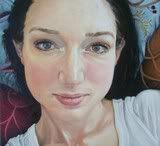
Photo shown is my Self-Portrait, in oil paint (top of post). Cartoon: Gary Larson's "Far Side."

Elise in Wonderland (2)

Photo Sharing and Video Hosting at Photobucket Photo Sharing and Video Hosting at Photobucket


The exciting developments continue.... News anchor Ginger Gadsden of Channel 10's "News This Morning" show is interested in having me do an interview. Writer Sean Lyons, of the lifestyle magazine "Everseen" in Punta Gorda, may be writing a story on me. And thanks to Alan Bridges, I met many wonderful people this weekend, including Amy Scherzer, the Tampa Tribune's education and society reporter, Aaron Fodiman, publisher of Tampa Bay Magazine, Bob and Martha Margolis, and Trish and Paul Melech, and so many others.

I am also currently working on a new oil painting for a client who must remain unnamed: he is commissioning the portrait for his family as a surprise Christmas gift...