...
My career story is a love story. I just realized that. Art was my first love. I started out as a dreamy-eyed little girl who wanted nothing more than to read fairytales and draw pictures of princesses. The books changed to Jane Austin and the Bronte sisters, and the pictures became portraits and life-drawn sketches, but for the most part, that dreamy identity remained astonishingly intact all the way through the rough and tumble of high school.
When I went to Duke, I took the Arts Focus classes, staffed the literary magazine and contributed art and poetry to its pages, and joined AOII, where I provided the sorority its every t-shirt design, poster design, and bridge painting. I drew more portraits. I studied abroad in Paris, where I visited an endless supply of museums from the Louvre to the Musee d'Orsay to Rodin to Picasso. And I drew more portraits. In my senior year, Duke Student Government commissioned me to create the art for a poster advertising that year's Homecoming festivities. They paid me $550 and I was thrilled.
My love for art was hands-on, tangible, vibrant: a living thing. My interest in law lay more in the line of a detached admiration. I appreciated the legal dramas I saw on TV and other media; I greatly respected what lawyers were able to achieve. “To Kill a Mockingbird” was one of my favorite books, but I wanted to be writing the novel, or painting the courtroom scene, not arguing the case.
Does any of this sound like someone headed for law school? No.
But at the same time, law was a suitor that was more than willing to have me. My LSAT score and my grades, especially in the English classes, made me a great catch, and the University of Florida, the one school I'd applied to, opened welcoming arms. My family approved of the match: not one of them had ever been an attorney, and I believe that made them all the more convinced that it was the perfect career choice. I felt pressure to choose the career that was steady, lucrative, and respected. I was sure I did not have the guts to stomach a life wedded to the volatile, self-revelatory world of art.
So, I went to law school. I stayed away from art for the next three years, and I had to force myself through each day of studying precedent and statutes. But I didn't want to be a quitter. I worked hard, graduated with honors and a certificate for commitment to pro bono work, passed the Bar on my first try, and felt extremely proud. I tried to persuade myself that I was well-matched to this career. I even took the Myers-Briggs Personality Test online and fudged the answers to make it say that my personality was best-suited to become an advocate/counselor/lawyer. I told myself I didn't miss art at all. Then I went to work. I started out with a boutique law firm that took national cases, defending individuals and corporations accused of white-collar crimes. I hated it. I was working long hours, including occasional all-nighters, and my brain was so busy running on a work treadmill that it was starving for downtime, for dreaminess and idle philosophizing. I started to view my impressive downtown skyscraper office as a prison, and my impressive tailored suits felt like prison-wear.
I tried a different type of law firm, one that was smaller-scale, more laid-back and casual, and which offered more pro bono services. The firm worked mostly with plaintiff's personal injury claims and class action suits. Life was better, but it still felt weirdly... wrong.
Around this time, my boyfriend of that past year proposed to me. I accepted, but my intuition told me he was the wrong person for me. I broke off the engagement within the month. I began to consider that maybe a career was a sort of marriage. If so, I'd gotten married to LAW too quickly. I had settled for the wrong “person.”
Just a few months after breaking off my engagement, I followed by
breaking up with my career. And over the course of the next several months, I focused on gathering up the courage to revisit my old love, to see if Art would take me back. Art and I reunited, and everything was amazing: passion, fireworks, better than ever before. I still felt afraid of the risks, but I was buoyed with optimism, thrilled with possibilities.
That was the honeymoon period. I had to wake up to the fact that even work you love – is work. I had to discover unknown wells within myself of discipline, motivation, and time-management. Maybe a marriage between a husband and wife is like that, too.
In a law firm, you have three categories of worker: the grinder, the minder, and the finder. The grinder cranks out the grueling (billable) hours and is least well-paid. The minder manages the business affairs. The finder finds clients, is most valuable, and best-paid. When you are a one-person business enterprise, you are grinder, minder, and finder. Fortunately, I love this grind, and I'm not too bad at minding shop. And the finding is often my favorite part, because it feels so good when people appreciate my art, and/or take interest in this crazy love story at the heart of my career change.
In the end, every day that I wake up and make art for my living is another day of creating my own happily ever after. I don't have the whole canvas painted yet, but I'm working on it...
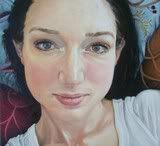
Photos in this post show my Sketch of a Model (above top) and an image, taken by a friend, of a rainbow landing on my home studio (above right).
Wednesday, January 23, 2008

Tuesday, November 28, 2006
How Picasso explained the afterlife to me:
Note: I have searched everywhere for the painting that I describe below, which was part of a traveling collection. I can't find it anywhere on the web. Maybe I have the name wrong, or maybe it's not catalogued. Picasso created over 22,000 works, including sketches, so I know it's out there somewhere. The Picasso pieces you see accompanying this post are: Joueur de Diaule Assis (1958) (below left) and Acrobat (1930) (below right). I was 21 and studying abroad in Paris when I learned that my grandmother—-my mother's mother—-was dying. I was actually standing in the basement of the Musee Picasso when I got the phone call. I turned around, completely shocked and numb, and ran smack into a work of Picasso's entitled Le Joueur du Football, or “The Soccer Player.” It must be obscure: it was a very small artwork, depicting the player as an amoeba-like form, and in fact the form was only recognizable as a human figure because Picasso gave it five extremities (head, arms and legs) and dressed it in a soccer uniform.
Maybe I was in denial, and wanted to concentrate on something other than my grandmother's death, but I stood in front of this picture for a long time. There wasn't anything in the picture that seemed typical of Picasso: it was a roughly sketched, preliminary piece of work, relegated to a little-traveled corner of the Museum's basement.
As I stood staring at the picture, it occurred to me that the blob-like form resembled a paper cut-out doll. I imagined taking scissors and cutting along the outline of the figure. And I thought: if I then curled the extremities of the paper figure inward, the shape would change from two dimensions into a three-dimensional sphere, a ball. The head, arms, and legs of the soccer player were like connected jigsaw puzzle pieces that fit almost perfectly together, with only a very little overlap in the finished spherical form.
And this made sense to me: a soccer player that transforms into the soccer ball. Picasso invented cubism, and here he had found another way to show the transformation from two to three dimensions. It made me think, how do I know I'm not a two-dimensional paper figure in a larger universe?
Maybe God is an artist, and what we call death is really the experience of being cut out of this paper life by The Artist's hand. I'd never really thought about the meaning of an afterlife before.
Now I envisioned my grandmother transforming and entering an unimaginable new dimension of unity and wholeness, a place where the focus would no longer be on the individual but on the universal, a place where the puzzle finally made sense... I thought of my life as being no more than an illustration of the game we want to play, and the afterlife as being the real, the authentic, the genuine experience of this virtual reality. A week later, I came home, and I was with her when she died: I saw her entire face relax into a sweet tranquility. I know she's part of something amazing out there in the next world.